Texas Instruments
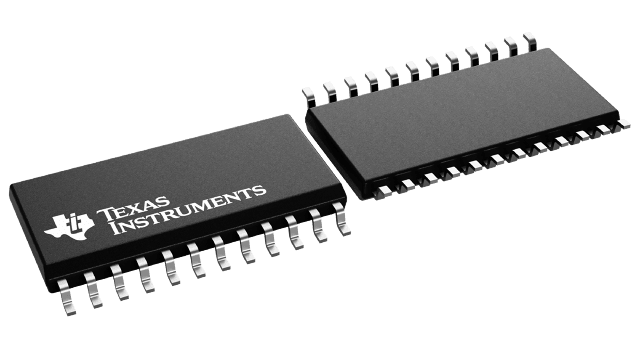
SN74HCT652DWR
SN74HCT652DWR
Regular price
$0.42 USD
Regular price
Sale price
$0.42 USD
Unit price
per
Couldn't load pickup availability
SN74HCT652DWR Texas Instruments - Yeehing Electronics
Octal Bus Transceivers And Registers With 3-State Outputs
Pricing (USD)
| Quantity | Unit Price |
| 1 — 99 | 1.606 |
| 100 — 249 | 1.326 |
| 250 — 999 | 0.953 |
| 1,000 + | 0.42 |
The above prices are for reference only.
Specifications
| Manufacturer | Texas Instruments |
| Product Category | Bus Transceivers |
| RoHS | Y |
| Logic Family | 74HCT |
| Input Level | TTL |
| Output Level | CMOS |
| Output Type | 3-State |
| High Level Output Current | - 6 mA |
| Low Level Output Current | 6 mA |
| Propagation Delay Time | 53 ns |
| Supply Voltage - Max | 5.5 V |
| Supply Voltage - Min | 4.5 V |
| Minimum Operating Temperature | - 40 C |
| Maximum Operating Temperature | + 85 C |
| Package / Case | SOIC-24 |
| Packaging | Reel |
| Function | Tri-State Octal Bus |
| Height | 2.35 mm |
| Length | 15.4 mm |
| Number of Circuits | 8 |
| Operating Temperature Range | - 40 C to + 85 C |
| Product | CMOS |
| Series | SN74HCT652 |
| Technology | CMOS |
| Width | 7.52 mm |
| Brand | Texas Instruments |
| Mounting Style | SMD/SMT |
| Number of Channels | 8 |
| Supply Current - Max | 8 uA |
| Operating Supply Voltage | 4.5 V to 5.5 V |
| Polarity | Non-Inverting |
| Product Type | Bus Transceivers |
| Factory Pack Quantity | 2000 |
| Subcategory | Logic ICs |
| Triggering Type | Positive Edge |
| Unit Weight | 0.022025 oz |
For more information, please refer to datasheet
Documents
| SN74HCT652DWR Datasheet |
More Information
The HCT652 devices consist of bus-transceiver circuits, D-type flip-flops, and control circuitry arranged for multiplexed transmission of data directly from the data bus or from the internal storage registers. Output-enable (OEAB and OEBA) inputs are provided to control the transceiver functions. Select-control (SAB and SBA) inputs are provided to select real-time or stored data transfer. A low input level selects real-time data; a high input level selects stored data. Figure 1 illustrates the four fundamental bus-management functions that can be performed with these devices.